Temel Bilgiler
Regular health checks with PCOS: which tests and how often?
Blood pressure, blood sugar, cholesterol, mood and sleep: a plain-language summary of the checks the guideline recommends for women with PCOS, and how often.
Published · 6 min read
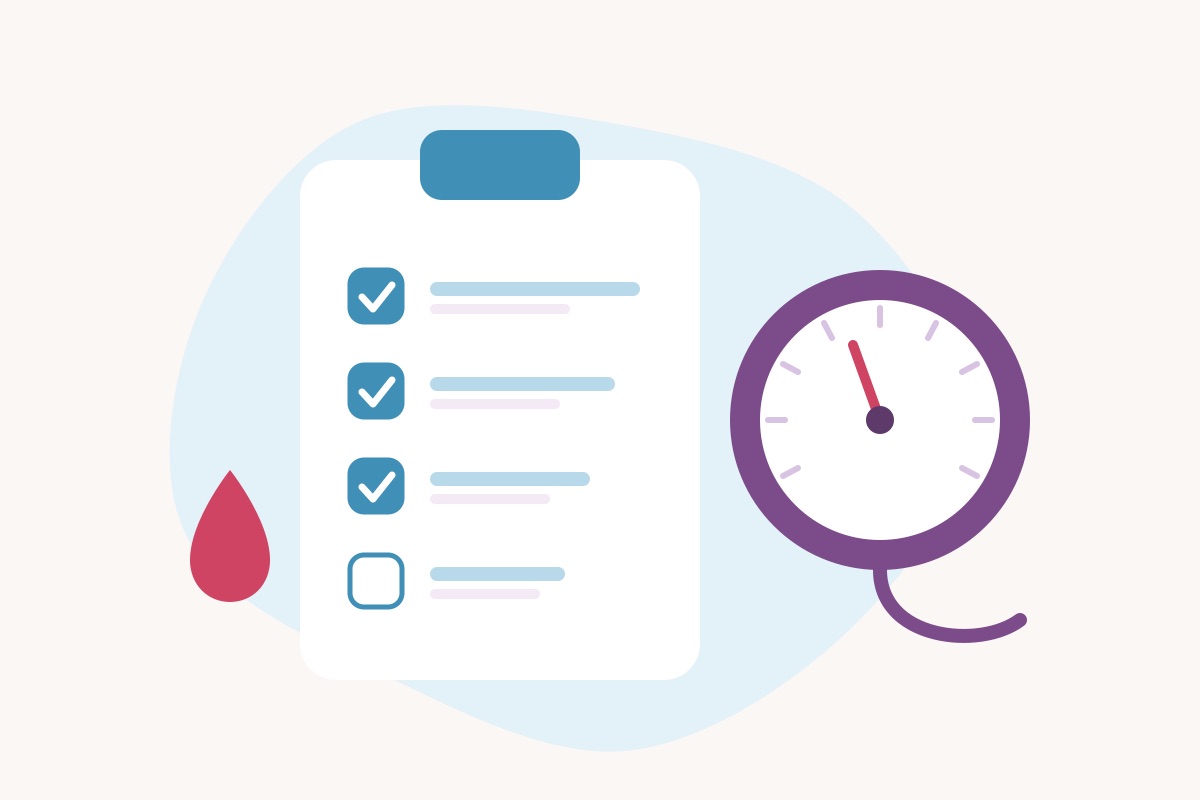
PCOS is not only about your cycle; it can also affect blood sugar, heart health and mood. Most of these effects develop quietly, without obvious symptoms. Regular checks are the easiest way to notice changes early and to feel more in control.
In short: The 2023 International PCOS Guideline recommends checking blood pressure once a year, blood sugar every 1–3 years depending on your risk, and cholesterol at diagnosis. Mood and sleep are part of these checks too. Check-ups don't make you a "patient"; they help you stay in charge of your health.
Why regular checks?
Women with PCOS have a several times higher risk of impaired glucose tolerance (blood sugar coming down more slowly than it should) and type 2 diabetes, independent of weight [2]. So these checks are not only for people with a higher weight; PCOS occurs at every weight, and the checks matter for everyone.
The risk of cancer of the lining of the womb (endometrial cancer) has also been found to be about 2–3 times higher with PCOS [3]. That may sound frightening, but the absolute risk is still low. What matters is knowing when to see a doctor.
The aim of check-ups is not to worry you. When something is spotted early, it can often be managed with simple steps.
Recommended checks at a glance
Under the 2023 International PCOS Guideline, the main recommended checks are [1]:
| Check | How often? |
|---|---|
| Blood pressure | Once a year, and when planning a pregnancy |
| Blood sugar | At diagnosis, then every 1–3 years depending on risk |
| Cholesterol (lipid profile) | At diagnosis, then depending on risk |
| Mood | Depression and anxiety, for all women with PCOS |
| Sleep | Questions about snoring, waking unrefreshed and daytime sleepiness |
This table is a general framework. Your doctor decides the right frequency for you based on your health history and risk factors.
Blood sugar: which test and why?
The guideline recommends the 75 g oral glucose tolerance test (OGTT) as the most accurate way to assess blood sugar, regardless of weight [1]. Fasting glucose or HbA1c (a test showing your average blood sugar over the last 2–3 months) can also be used, but they may miss some problems.
How is an OGTT done?
- You fast for a set time the night before; your doctor or the lab will tell you how to prepare.
- A blood sample is taken in the morning on an empty stomach.
- You then drink a sugary drink.
- Usually two hours later, another blood sample is taken. You will be asked to sit and wait in the meantime.
The test takes a while but is simple. Bringing a book or headphones makes the wait easier.
Heart and blood vessel health
Blood pressure should be measured once a year, and also when you are planning a pregnancy [1]. It is quick and painless and can be done at many pharmacies or by your family doctor.
A lipid profile is a blood test showing your cholesterol and triglyceride (a type of blood fat) levels. The guideline recommends it at diagnosis and then repeating it depending on your risk [1].
Weight and waist measurements are sometimes part of this assessment. The guideline recognises that weight stigma is common and harmful, and recommends asking for your permission before weighing you [1]. If you don't want to be weighed, you have the right to say so.
Mood, body image and sleep
Moderate to severe depressive symptoms are about 3 times, and anxiety symptoms about 5 times, more common in women with PCOS [4]. That is why the guideline recommends that all women with PCOS are assessed for depression and anxiety; the ideal interval is not yet known [1].
The guideline also gives weight to [1]:
- Your relationship with food: eating disorders can occur at any weight. Routine screening is not recommended, but if eating feels hard for you, you can tell your doctor.
- Body image and sex life: the impact of PCOS in these areas is recognised, and talking about them is part of a health check too.
- Sleep: obstructive sleep apnoea (breathing repeatedly stopping during sleep) is more common with PCOS regardless of weight. You should be asked about snoring, waking unrefreshed and daytime sleepiness.
What to know about the womb lining
No routine screening test is recommended for endometrial cancer [1]. Paying attention to symptoms is what matters. Going a long time without a period can mean the womb lining is not being shed regularly. The guideline counts any cycle longer than 90 days as irregular [1].
Talk to your doctor if:
- You have gone more than three months without a period
- You have bleeding between periods or at unexpected times
- The amount or length of your bleeding has clearly changed
If you are planning a pregnancy
With PCOS, the risks of gestational diabetes, high blood pressure in pregnancy and preterm birth are higher [1]. The guideline therefore recommends an OGTT before pregnancy. If that has not been done, the test should be done at the first antenatal visit and again at 24–28 weeks [1]. Checking blood pressure before pregnancy is also recommended.
What you can do
- Make a check-up list: write down the dates of your last blood pressure, blood sugar and cholesterol checks.
- Keep your results: change over time matters more than a single result. Keep copies in a folder or on your phone.
- Take notes before appointments: write down your cycle pattern, sleep, mood and any questions.
- Set a reminder: add your next check-up date to your calendar.
- Don't hesitate to ask: "What does this result mean for me?" and "When is my next check due?" are perfectly good questions.
Frequently asked questions
My weight is in the normal range. Should I still have a blood sugar test?
Yes. The risk of blood sugar problems is higher with PCOS independent of weight [2]. The guideline also recommends the OGTT as the most accurate test regardless of weight [1].
My fasting glucose was normal. Do I still need an OGTT?
Fasting glucose may not reveal every blood sugar problem. An OGTT shows in more detail how your body handles sugar. You and your doctor can decide together which test suits you.
Which doctor does these checks?
Blood pressure and blood tests can often be arranged by your family doctor. A gynaecologist or an endocrinologist may also be involved in your care. What matters is that checks happen regularly and the results are kept together.
I'm scared of check-ups. What if something bad turns up?
That is a very understandable feeling. But checks don't create problems; they only make visible what is already there. Changes spotted early are often easier to manage.
This article is for information only; agree on a check-up plan that suits you with your doctor.
Sources
- Teede HJ et al. Recommendations from the 2023 International Evidence-based Guideline for the Assessment and Management of PCOS. Fertil Steril. 2023; 120(4): 767-793. PubMed
- Kakoly NS et al. Ethnicity, obesity and the prevalence of impaired glucose tolerance and type 2 diabetes in PCOS: a systematic review and meta-regression. Hum Reprod Update. 2018; 24(4): 455-467. PubMed
- Barry JA, Azizia MM, Hardiman PJ. Risk of endometrial, ovarian and breast cancer in women with polycystic ovary syndrome: a systematic review and meta-analysis. Hum Reprod Update. 2014; 20(5): 748-758. PubMed
- Cooney LG et al. High prevalence of moderate and severe depressive and anxiety symptoms in polycystic ovary syndrome: a systematic review and meta-analysis. Hum Reprod. 2017; 32(5): 1075-1091. PubMed